

Timely, targeted, and informative messages can motivate young workers to continue pursuing their qualifications. Employers can adopt these social science tips to better support students at work.
My colleagues and I presented our research, ‘Using Behavioural Messages to Retain Vulnerable Apprentices and Trainees,’ at the National Centre for Vocational Education Research (NCVER) annual conference. We discussed how using behavioural messages can stop first year students from dropping out of their courses and employment contracts.
Behavioural messages
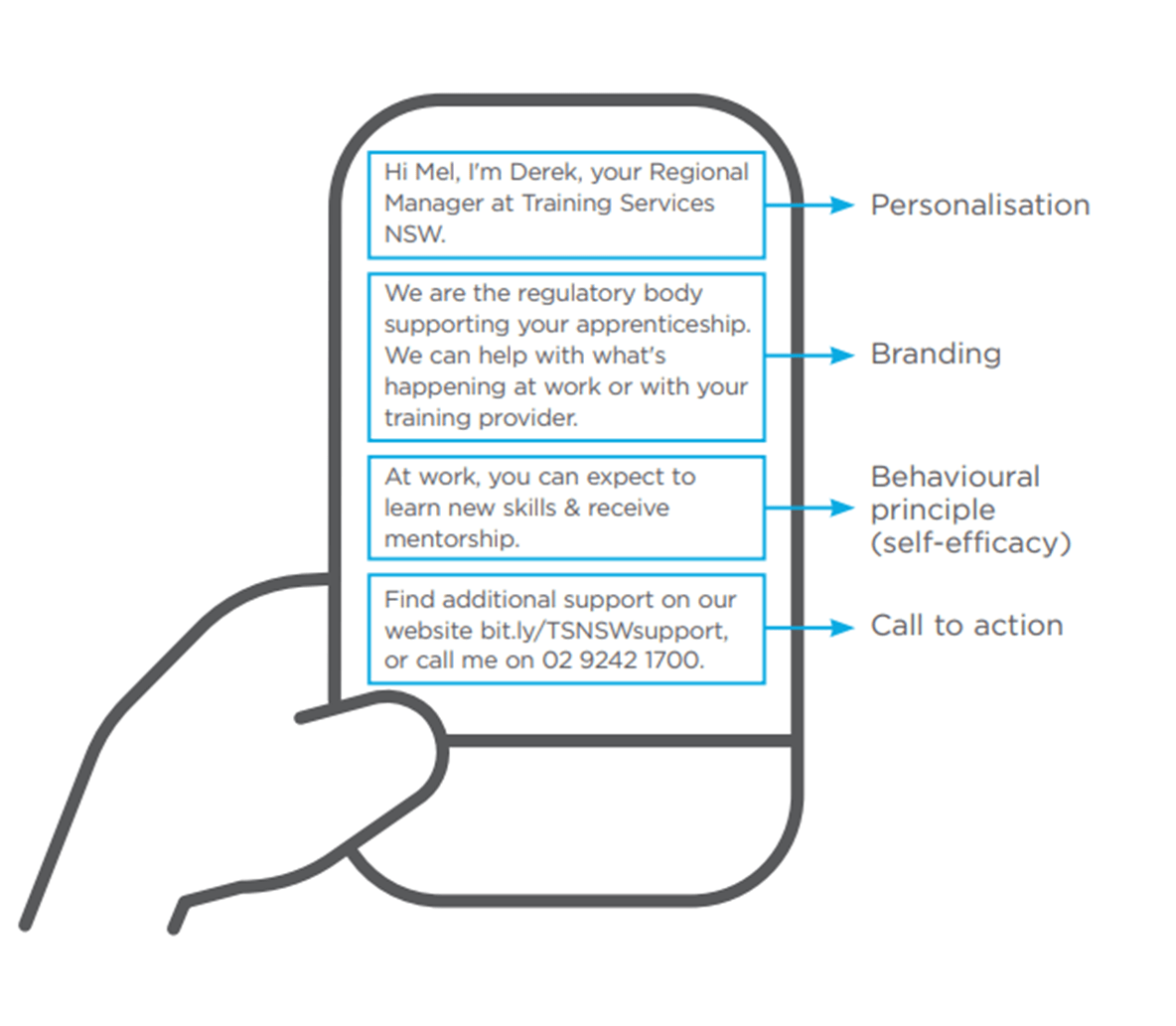
We significantly reduced dropout rates for apprentices and trainees using behavioural prompts sent via SMS. Our messages used the following behavioural principles:
Change habits: provide personalised prompts to students, encouraging them to seek help by visiting online resources or calling their local regional office.
Timeliness: we sent messages at pivotal points during the learning journey. We established an early routine at the time of enrolment, sending behavioural texts every two months.
Fair Go: half of the messages we tested built self-efficacy by encouraging students to advocate for their rights. E.g. Workplace rights, Training Plan.
Incentives: the other half of the messages highlighted rewards and benefits of continuing their study. E.g. Concession cards, wage increases.
Impact
The self-efficacy message proved most effective.
Our messages also led to almost 6,000 clicks to resources on the Training Services New South Wales website.
We additionally received over 1,000 SMS responses and phone calls for support, as well as appreciation for reaching out.
Two strategic goals of Training Services is to improve support for students as well as build their brand, so that students know what services they offer. Messages from students reinforced that our messages positively impacted these aims.

Our messages are now used throughout the year, across New South Wales.
Tips for employers
Emphasise behavioural principles to boost proactive self-help behaviour. E.g. Workplace rights, seeking mentorship and planning ahead.
Include personalised messages with a salient call to action. Start with the learner’s first name. Sign off from a local manager.
Provide a direct link to a relevant webpage. Optimise these webpages for mobile, as workers are often on-the-go when they receive messages.
Prompt staff with an action they can do on the spot. E.g. ‘Hi Michelle. Do you feel like you’re on track with your on and off-the-job training? Your employer & RTO should help you progress. http://bit.ly/TrainingProgress Call me if you need a chat 02 9242 1700.’
Consider timeliness of behavioural messages. From April to November, we tested various messages. The highest engagement was on Wednesdays, from 11am to 12pm.
Focus on timely reminders of key deadlines that could support training progression. E.g. Our second message was about finalising Training Plans, which outline training and assessment for apprentices and trainees. Training Plans must be completed before learners receive their qualification. As it’s up to the employer to lodge these, some Training Plans are never finalised. This leaves learners vulnerable.
Measure longer term impact. We initially tested outcomes over 12 months. Training Services continues to measure each campaign they send. This helps them respond to problems in a timely way, and update their contact records, as otherwise students don’t think to do this themselves.
Subscribe for free updates
You’ll receive an email each time we post a new article. We never share your data with anyone. Subscription is forever free.