

How can you encourage your customers to take up free support services? We look at how to get employers and workers to complete a survey sent via SMS, and sign-up for emergency disaster relief.

Summary
- An organisation wanted to encourage farmers and businesses affected by drought to fill in a survey, with the link sent via SMS
- The SMS does not show why the survey is important, and the survey was long and complicated
- I crafted a short, simple, personalised SMS and improved the survey, so that it was optimised for touch screen phones
- The message appealed to pro-social norms of helping other farmers get the help they need
Background
An organisation, whom we’ll call Industry United, wanted to encourage drought-affected farmers and businesses who were impacted by the drought, and who had recently completed a subsidised skills-training program, to complete a survey. Industry United would send their customers a survey via SMS, asking them how they were affected by drought, and encouraged them to seek assistance via Industry United’s emergency disaster relief program.
What We Did
Industry United approached me to improve their SMS message about the survey.
I provided advice about Industry United’s existing message and survey, and how to use behavioural science to improve the SMS.
How We Did It
I conducted a rapid literature review and analysis of the business-as-usual Industry United message and survey.
The current Industry United SMS simply asks customers to fill in a survey, and it provides a long URL link to the survey on Microsoft Forms. The message does not identify why the survey is important, what the customers get out of it, how long it takes, and what will be done with their input.
Additionally, the Industry United survey includes 36 questions that were long-winded, complicated, and could not be easily completed on the spot. Industry United was not directly using these details to tailor their services for the drought program.
For example, the survey included multiple questions about the participants’ business, including their ABN, postal address, address of property stock, distance of stock, financial counselling service, copies of rate notices and log registration papers, and percentage of gross income affected by drought. The survey also linked to dense regulation guidelines, and asks the participants to tick their understanding of the guidelines. It is unclear how this is relevant.
People who are under strain, or who lack time, or resources, do not have the cognitive bandwidth to focus on complex tasks, and they are forced to make mental trade-offs (scarcity mindset). They are more likely to make sub-optimal decisions, perform poorly, or not be able to focus on long-term benefits.
- The Industry United survey questions did not directly relate to the drought training course.
- While the survey questions helped Industry United to screen eligibility for their drought relief program, the questions are difficult and require participants to dig up dense information.
- People experiencing drought or natural disasters have often lost documentation. Additionally, their workplace, home, and personal lives may have incurred devastating losses.
To improve the Industry United message, I used existing studies on how to motivate customers to complete surveys.
I drew on our existing research on how to send effective SMS campaigns:
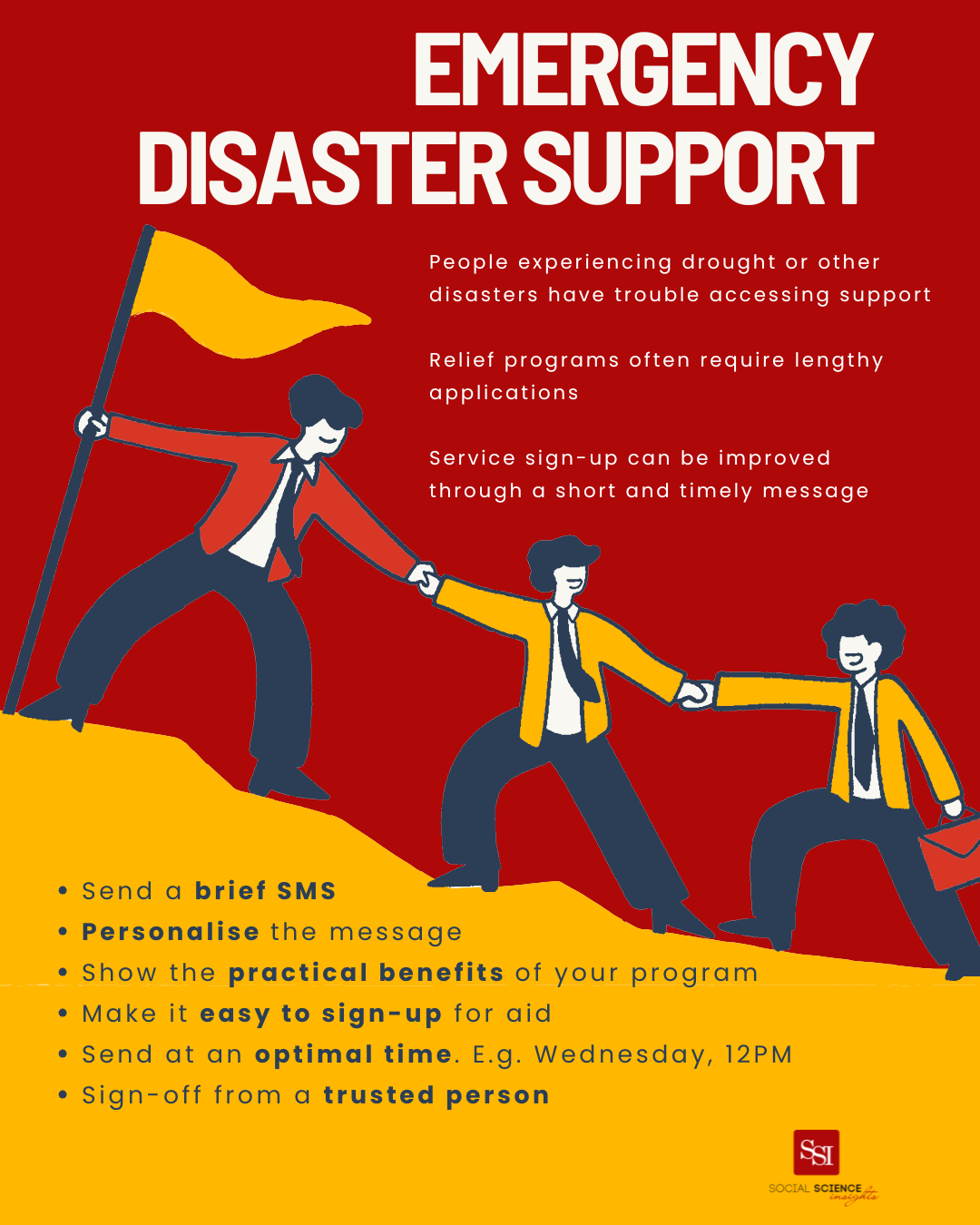
- Use personal details (personalisation): I showed Industry United how to import their existing administrative data to make the message more compelling.
- Keep the message simple (simplification): I reduced the length of the message and focused on the benefits of completing the survey (detailed below).
- Tell people what they can do on the spot (call to action): I changed the focus of the message and the survey. The survey only included 10 questions, including demographics, and it included opting in for relief support, rather than filling in personal and business details.
- Send the message at an optimal time (timeliness): messages were sent on weekdays, on Wednesday, over lunch.
- Sign-off from an influential person (messenger effect): the message comes from a dedicated message service, which lists Industry United’s name on their customer’s phone, rather than a generic phone number. The message is signed off from their local Industry United manager.

What We Found
Industry United sent 1,122 SMS as well as 70 additional emails and received a significant response from their customers.
The message sent was as follows:
Hi Paula. You can help students and employers affected by drought to get the help they need. We’re contacting you because you participated in the Drought program in December. By filling in this 3 minute survey, your feedback will improve services for thousands of workers affected by drought in NSW, so they get the right support. Click here: https://bit.ly/drought-program
– Jane Smith, Manager, Industry United
Reply Stop to opt out
This message uses the following behavioural science principles:
Appeal to what the audiences cares about (incentivisation): Our self-esteem gets a boost when we help others (pro-social motivation). The psychological reward for helping others is highly satisfying and ‘deeply ingrained.’ We get a ‘warm glow‘ from helping charitable causes that benefit people facing adversity (pro-social incentives). In particular, when the stakes are low (e.g. making a donation), we will choose to work harder for other people.
Additionally, we prefer people and situations that remind us of ourselves (affinity bias). We are therefore more likely to help others like ourselves, especially when we are reminded about our community needs.
- The revised Industry United message asks customers to complete the survey to help others ‘get the help they need’
- The message appeals to the warm glow of altruism, by showing how the information will be used: ‘your feedback will improve services for thousands of workers affected by drought in NSW.’
Make it relevant (personalisation): Name the training course the person completed, and the date they completed it. These fields can be easily imported from your administration database into messaging platforms. Localise the message, and include the manager’s name in the sign-off.
- The new Industry United message includes the customer’s name (Paula)
- Details of their training course (Drought program, December)
- Their location (NSW, New South Wales)
- Sign-off from their local manager (Jane Smith, Industry United)
Keep it quick and easy (simplification): Ensure the survey will take three minutes or less to complete. Keep the SMS under 500 characters. This includes an opt-out option, which is a legal requirement under the Spam Act.
- With my advice, Industry United reduced the number of survey questions so it can be completed in ‘3 minutes’
- The SMS is 440 characters with spaces, including the opt-out message.
Highlight key information (salience): Show that the benefit of completing is helping other people like you.
- The new SMS says: ‘You can help students and employers’
Ensure a smooth experience on mobile (optimisation): Ensure the survey is short and easy to complete on a touch screen phone. Measure the number of clicks on the survey.
- Use a program such as Bitly, that shortens a long link, saving on SMS characters to keep the message shorter
- You can also modify the URL, to make the link more meaningful to your audience, and thus increase trust
- This also maintains your clients’ anonymity, as you will not see who clicked on your link specifically, only how many people in total clicked on the link.
How Social Science Helped
Social science theory improved the message and survey, in particular, understanding the audience, how to motivate behaviour, and how to craft an effective, measurable outcome.
Social science methods were used to test the message. This includes targeting the message using existing information (administrative data), and tracking actions (clicks on link, survey completions).
Credits
Source: Header image, top image, and second image.
 Social Science Insights