
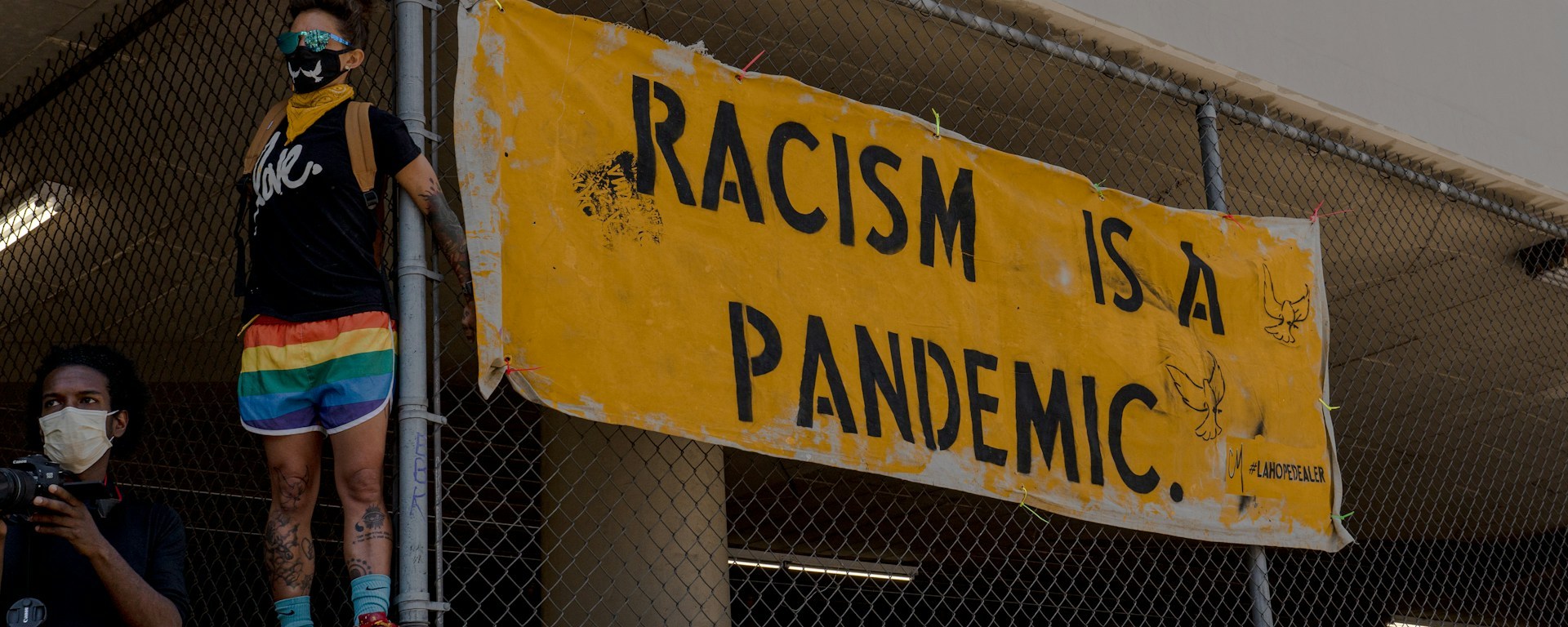
The new book chapter, ‘Critical Race Studies and Intersectionality Responses to COVID-19,’ presents a case study of how the welfare state exercises multiple domains of power to maintain racial inequality, even during the public health crisis of COVID-19. Read the abstract and an excerpt below.
My book chapter is available to purchase online as an individual chapter, or you can purchase the hardback book, ‘Overlapping Inequalities in the Welfare State.’ The book is edited by Dr Başak Akkan, Dr Julia Hahmann, Dr Christine Hunner-Kreisel, and Dr Melanie Kuhn, and it is published by Springer.
The book is ideal for educators and practitioners seeking to address inequalities within welfare policies and governance.
Abstract
My chapter shows how race is a pervasive system that categorises and stratifies people in ways that maintain institutional and systemic inequality. Race has impacted the evolving management of public health responses to the Coronavirus (COVID-19) pandemic around the world. In Australia, state governments imposed harsh policing of migrant and refugee working class people that were not applied to white middle class people. The Government failed to meaningfully engage Aboriginal and Torres Strait Islander people in early public health planning, leaving communities who were at high risk from the virus to autonomously coordinate action without substantial state support. My chapter presents a case study of the webseries, Race in Society, co-hosted with Professor Alana Lentin. The series featured Aboriginal and Torres Strait Islander scholars and practitioners, and other people of colour researchers from Australia who examined public discourses of race and the pandemic. My chapter uses the concept of intersectionality to illustrate how the welfare state exercises multiple domains of power to maintain racial inequality, even during the public health crisis of COVID-19. My chapter provides guidance for educators and researchers on how to apply critical race perspectives into their own scholarship, teaching, and activism.
Excerpt: The Economics and Social Costs of COVID-19
In the final episode of Race in Society (2020g), Alana Lentin and I were joined by two guests to examine the impact of the COVID-19 crisis on undocumented migrant workers, whose labour is being exploited. The economy depends upon the work of racialised people. This was amplified during the pandemic. This section demonstrates how migration status is another axis of intersectionality that complements critical analyses of the welfare state.
Our first guest, Sanmati Verma, is from Punjab, now living on unceded Bunurong country (south-east Victoria). Sanmati is an Accredited Specialist in Immigration Law. She has previously analysed some of the punitive immigration policies that have impacted undocumented workers (Verma 2019). Sanmati explains that the term undocumented worker is mostly used to describe someone without visa status or people who have precarious visa status that impose stringent limits. Sanmati says there is an estimated 100,000 undocumented people in Australia. They are not eligible for economic assistance and could not apply for welfare support during the pandemic.
Many undocumented migrants fall into so-called ‘essential services’ sectors.’ For example, they do work that cannot be done from home, such as contract cleaning, farming, and care work. To fill economic gaps, new visa provisions permitted people to enter critical sectors, and receive a 408 COVID-19 visa for 12 months on a rolling basis, so long as they continued doing frontline work (Department of Home Affairs 2022). Sanmati says offering short-term visas in high COVID risk areas, while denying other social assistance, opens up potential for exploitation. This also makes the basic right to access social welfare contingent on doing COVID work from which other Australians are protected. Ethical distribution of the welfare state is thereby weakened.
Our other guest is Professor Sujatha Fernandes, who is Indian-American-Australian, originally from Mangalore in South India. Sujatha is Professor of Political Economy and Sociology at the University of Sydney. Sujatha explains her research on ‘curated stories’ about undocumented migrant workers (Fernandes 2017). She examines media, academic, and social media discourses about racialised populations. She argues minorities “are often called to perform stories about being marginalised subjects.” These stories depend on racial stereotypes, including slavery, racial capitalism, or colonialism.
‘I think another stereotype that’s particularly around undocumented workers is that they’re often asked to talk about what value they bring to the economy and that they should be valued because their labour is valuable. And one of the things that some more critical social movement advocates have argued is that: why should they have to prove that they’re valuable to the economy just to be treated as human beings? We should see intrinsic value and worth in them as human beings.’
Sujatha notes that racial stereotypes have been prevalent throughout the COVID-19 pandemic. This includes the early but insidious references to the ‘Chinese virus,’ which incorrectly typified Asian people as ‘virus spreaders.’ Moreover, migrants who broke curfew were named and shamed in national media (cf. Zevallos 2021b). Major newspapers published their photos and employment details. White affluent people who did the same in highly infectious areas remained anonymous.
We asked our guests to describe practical ways that we can build solidarity between Aboriginal and Torres Strait Islander people, and undocumented workers. Sanmati says non Indigenous people need to understand the legal fiction of Terra Nullius (as noted earlier, this the false idea that Australian land was unowned before colonisation). Sanmati also warns us to stop replicating arguments about economic utility of migrants. This serves to reinforce the idea that legal status is legitimised by ability to do certain types of paid work. The language of solidarity can therefore reproduce class inequalities (Table 13.6).
Sujatha argues COVID-19 restrictions have been overextended, moving us towards a ‘police state.’ This includes higher penalties for protests, even after COVID restrictions eased. Sujatha suggests that we can support local organisations to help with mutual aid efforts, and to “push for policy changes, like sick pay, COVID leave, adequate health care for legal status.” Sujatha also calls for collective mobilisation:
- Actively support Black Lives Matter protests, frontline worker strikes, and other industrial action
- Contribute to funds to pay fines for these protestors
- Organising teach-ins
- Building coalitions between students, workers, and First Nations peoples.
Table 13:6
| Methodological questions | How can we apply this to our work? | Intersectionality and other critical race studies concepts |
| How does over-policing impact on racialised people’s participation in research? First Nations and other people of colour may be rightfully wary of participating in research where data collected about them may cause unintended harm | Seek training on the history and ongoing effects of over policing Follow informed consent guidelines developed by First Nations people. E.g., the right to self-determination, and ensuring First Nations people directly benefit from research (AIATSIS 2012) Share data and insights collected with racialised minorities, so they maintain Indigenous data sovereignty (Kukutai and Taylor 2016; Maiam nayri Wingara 2018; Walter et al. 2021; Walter and Suina 2018) | Cultural domain of power Self-determination Indigenous data sovereignty |
| How can we be more proactive about justice? Laws and policies have adverse impact on First Nations people. Non Indigenous researchers have contributed to these dynamics through inadequate awareness about legal and constitutional processes | Connect with First Nations people and other people of colour. E.g., in Australia, the Uluru Statement from the Heart invites non-Indigenous Australians to support a First Nations Voice enshrined in the Constitution, and a Makarrata (a Treaty with First Nations people, and truth telling about genocide and history) (The Referendum Council 2017) | Structural domain of power Constitutional rights |
| What can we do to address institutional racism? Penalties and infringements are often seen as the outcome of individual transgressions. Without a critical race perspective, we may fail to see how similar logic in our research practices may contribute to discrimination | Regularly invite review of research processes by critical race studies experts. Do this with a view to ‘debias’ how we design and carry out research | Disciplinary domain of power Institutional racism |
Read more: Critical Race Studies and Intersectionality Responses to COVID-19.
 Social Science Insights