

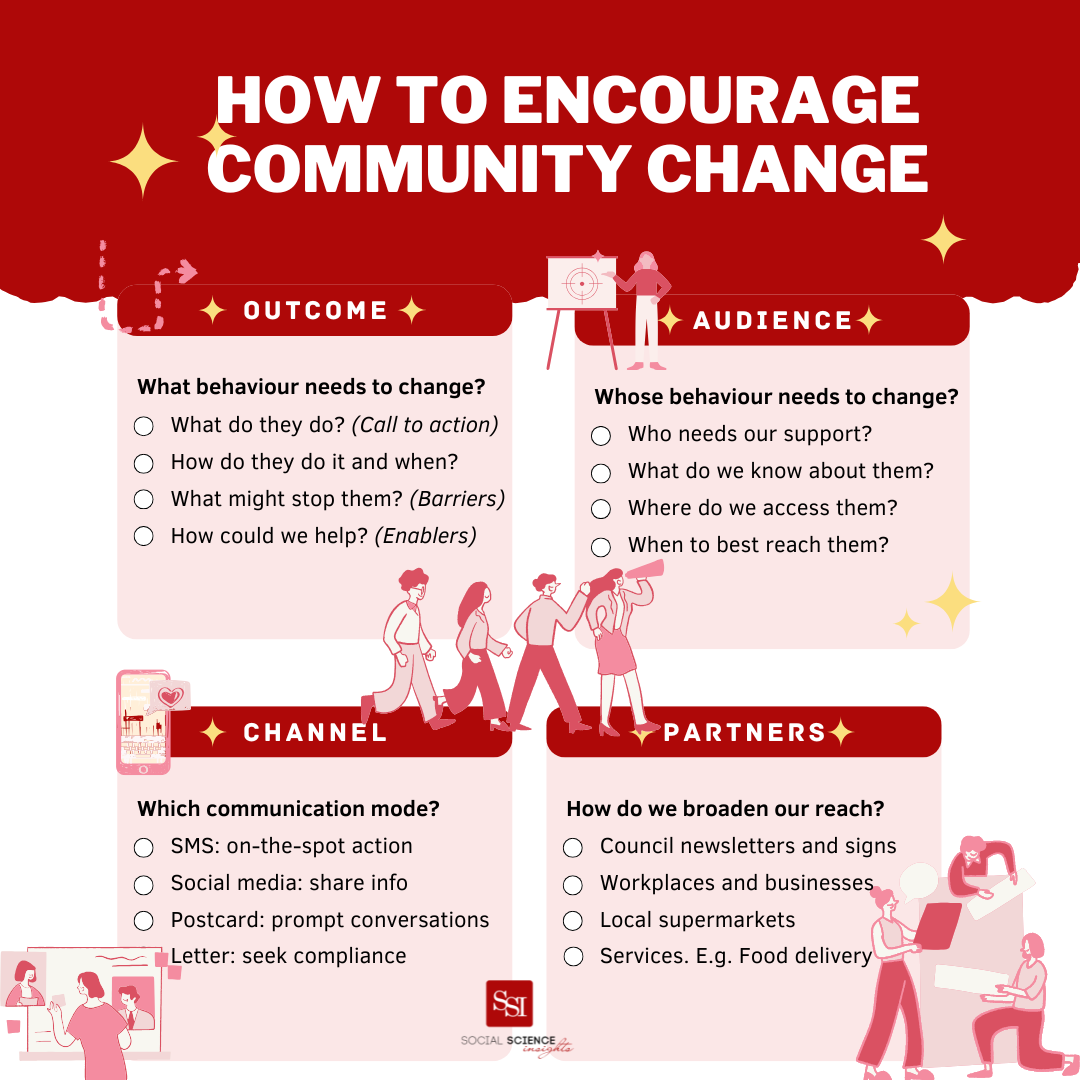
How can you use social science to encourage communities to change collective behaviours? We cover how to identify a behaviour that needs to change, how to target the key audience, how to encourage change, and the best mode of communication to reach the intended community. The provided check list will help you communicate effectively with local communities.

First, what’s the behaviour you want to change? Rather than trying to change people’s attitudes or beliefs, which are more deeply ingrained, focus on a measurable behaviour you can affect. Whether you feel positive about vaccination is an attitude. Signing up to get a vaccination is a behaviour. How do we achieve the latter? Send reminders to people who already have appointments with their doctor, and tell them that a vaccine ‘has been reserved for you.’
Second, you need to think about your audience: whose behaviour needs to change? What do you know about them? Where and when can you best reach them? Draw on the behavioural science evidence from the academic literature, such as randomised control studies, to make recommendations about different audiences.
For example, if you’re going to ask students or office workers to complete training, fill in a survey, read a blog post, have a conversation about workplace rights, and other minor behaviours, we find the best time is: Wednesdays, 11am to 12pm. See how we used timely messages to encourage vulnerable workers to keep studying.
Third, what’s your one call to action? What’s the one thing your audience needs do? What are the steps that people need to do in order to act, and then what might be some of the barriers and enablers to them completing that action? Whether sending an email, a SMS, or some other reminder, only include one call to action. For example, provide only one link to a website, rather than several links.
Fourth, what’s the best communication channel to reach your audience? Some messages are best delivered via SMS, others via social media, and others by putting up signs at specific venues where the behaviour is carried out.
For example, see how we used a text message to encourage take-up of emergency support.

Finally, think about matching your audience to the behaviour that you’re interested in changing, as well as to your channel. That is, consider carefully the best mode of distribution for how you’re going to get that message to your intended audience.
For example, if you’re interested in tackling misinformation, or telling the community about new rules or regulations, it’s no good sending information about when people are likely to be busy, such as peak shopping times, or during dinner time. When people have a specific task in mind they need to complete, they are less able to consider complex information. It is best to send such information to their home, via a postcard or letter, when they might have a little more time to consider new ideas.
For example, see how we redesigned a letter to encourage medical practitioners to refer patients to a free health service.
Alternatively, SMS works best for short messages people can action on the spot. Social media is useful for sharing brief information (one short paragraph).
Community leaders could leverage their existing council newsletters or their email list to send these public campaigns. Additionally, local government might partner with local businesses, supermarkets, or services, such as food delivery companies, to reach the broader community.
Some general tips are:
- Include only one request (call to action)
- Use simple language (simplification)
- Leverage the desire to help others who’ve helped us in the past (reciprocity)
- Provide a guiding principle, so they know what they need to do and how to do it (rule of thumb)
- Focus on facts, and don’t repeat myths if you’re tackling misinformation (mythbusting)
- Provide timely data to help reflection and encourage change (feedback loops)
- Appeal to people’s high opinion of themselves (ego-centric bias)
- Harness the power of social connections, such as ties to family and friends (social networks)
- Use trusted people from the local community (messenger effect). Don’t bother with celebrities or politicians. Peers are often more influential than famous figures
- Prompt when people are most receptive (timeliness)

Download our tips as an A4 PDF poster you can print.
 Social Science Insights