

Our quote of the month comes from Palestinian-American literary critic and postcolonialist scholar, Edward Said (1 November 1935 – 24 September 2003). We deep dive into his work on knowledge production and Orientalism. We see how this theoretical framework continues to have terrible urgency in the present-day.
Said theorised this term in its eponymous book, first published in 1978, to describe the ways in which ‘Western’ scholarship (primarily European and North American traditions) conceived so-called ‘Eastern’ societies through racist ideologies and imagery. Through art, poetry, plays, literature, and research, non-European societies positioned the Middle East, Asian, and Africa as ‘the other‘ – the subservient opposite of the West. This includes seemingly positive (though no less destructive) stereotypes of exotic and mystic practices of ‘primitive people,’ to negative caricatures of uncivility. These depictions serve the primary purpose of justifying and advancing Western imperialism, a narrative of conquest over ‘foreign’ territories, and oppression of other cultures.
‘For if it is true that no production of knowledge in the human sciences can ever ignore or disclaim its author’s involvement as a human subject in his own circumstances, then it must also be true that for a European or American studying the Orient there can be no disclaiming the main circumstances of his actuality: that he comes up against the Orient as a European or American first, as an individual second’
Edward Said, ‘Orientalism’ (1979: 11)
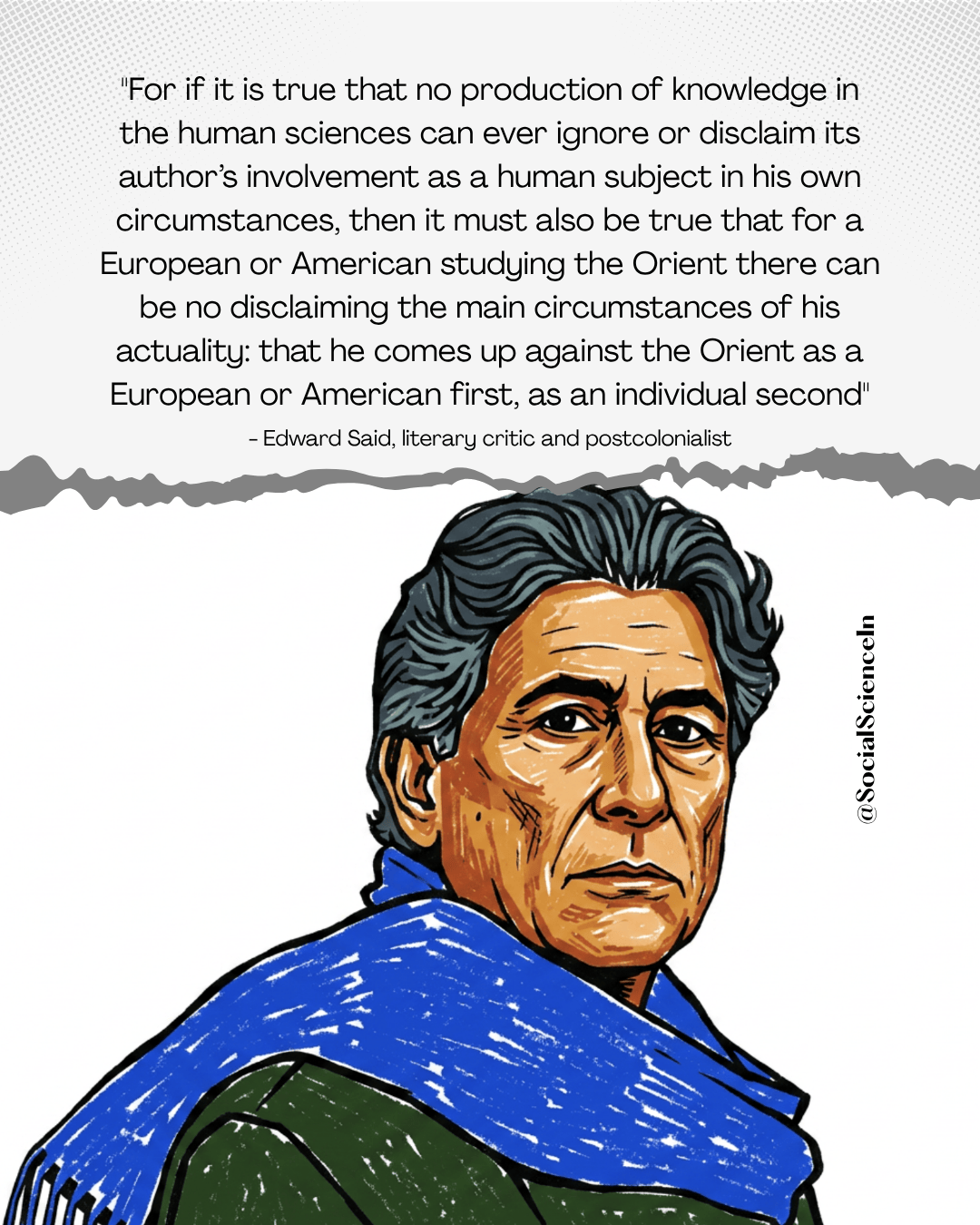
Said writes how his work is influenced by his experiences as a Palestinian man:
‘Much of the personal investment in this study derives from my awareness of being an “Oriental” as a child growing up in two British colonies. All of my education, in those colonies (Palestine and Egypt) and in the United States, has been Western, and yet that deep early awareness has persisted. In many ways my study of Orientalism has been an attempt to inventory the traces upon me, the Oriental subject, of the culture whose domination has been so powerful a factor in the life of all Orientals.’
Edward Said, ‘Orientalism’ (1979: 25)
He goes on to explain:
‘The life of an Arab Palestinian in the West, particularly in America, is disheartening. There exists here an
almost unanimous consensus that politically he does not exist, and when it is allowed that he does, it is either as a nuisance or as an Oriental. The web of racism, cultural stereotypes, political imperialism, dehumanising ideology holding in the Arab or the Muslim is very strong indeed, and it is this web which every Palestinian has come to feel as his uniquely punishing destiny. It has made matters worse for him to remark that no person academically involved with the Near East – no Orientalist, that is – has ever in the United States culturally and politically identified himself wholeheartedly with the Arabs; certainly there have been identifications on some level, but they have never taken an “acceptable” form as has liberal American identification with Zionism, and all too frequently they have been radically flawed by their association either with discredited political and economic interests (oil company and State Department Arabists, for example) or with religion.
‘The nexus of knowledge and power creating and in a sense obliterating him as a human being is therefore not for me an exclusively academic matter. Yet it is an intellectual matter of some very obvious importance. I have been able to put to use my humanistic and political concerns for the analysis and description of a very worldly matter, the rise, development, and consolidation of Orientalism.’
Edward Said, ‘Orientalism’ (1979: 27)
Said analyses examples of Palestinians depicted in Western texts, such as The Talisman by Sir Walter Scott, published in 1825; British-American historian, Bernard Lewis’ writing critiquing Palestinian struggles as ‘the return of Islam;’ educational resources, such as The Cambridge History of Islam; and even interpretations of the Bible; all of which skewer and diminish Palestinian history and the struggle for human rights. Said shows how the work of French author and Minister, Alphonse de Lamartine, writing in the 1800s, influenced later notions of Palestinian people as ‘the shadow that dogs’ the Israeli occupation:
‘Palestine was seen – by Lamartine and the early Zionists – as an empty desert waiting to burst into bloom; such inhabitants as it had were supposed to be inconsequential nomads possessing no real claim on the land and therefore no cultural or national reality.’
Edward Said, ‘Orientalism’ (1979: 286)
Sixteen years later, in the interview from 1994 (further below), Said critiques the Israeli Government’s occupation of Palestine, as well as Yasser Arafat’s (President of Palestine from 1989 to 2004 and President of the Palestinian Authority from 1994 to 2004) ‘tremendous incompetence’ that negatively impacted the Palestinian people. His insights, including the continued slaughter of Palestinian people, the destruction of public infrastructure, the lack of sovereignty, and poorly negotiated and ineffective peace deals, remain relevant today.
The International Science Council, which represents the social sciences, has addressed the ‘humanitarian crisis and devastation in Gaza and the continuing risks faced by scientists in the Palestinian territories.’ They note that Palestinian lives and knowledge are facing ‘catastrophe.’ The International Sociological Association similarly expresses alarm about ‘the human carnage… unfolding in plain view’ in Palestine, as well as the impact to freedom of speech of scholars addressing this political conflict around the world.
In summary, Orientalism continues to flourish in present-day genocide and dispossession, but it need not continue to be so. Said argues this is the role of the social sciences and humanities:
‘Positively, I do believe – and in my other work have tried to show – that enough is being done today in the human sciences to provide the contemporary scholar with insights, methods, and ideas that could dispense with racial, ideological, and imperialist stereotypes of the sort provided during its historical ascendancy by Orientalism. I consider Orientalism’s failure to have been a human as much as an intellectual one; for in having to take up a position of irreducible opposition to a region of the world it considered alien to its own, Orientalism failed to identify with human experience, failed also to also to see it as human experience. The worldwide hegemony of Orientalism and all it stands for can now be challenged, if we can benefit properly from the general twentieth-century rise to political and historical awareness of so many of the earth’s peoples.’
Edward Said, ‘Orientalism’ (1979: 328)
Subscribe for free updates
You’ll receive an email each time we post a new article. We never share your data with anyone. Subscription is forever free.