

Taking a look back at Ai Weiwei’s exhibition at the Biennale of Sydney, 2018. The work is called, ‘Law of the Journey, 2017.’ It tackles Ai Weiwei’s ongoing critique of European nations denying basic human rights to refugees.

The massive installation features gigantic rubber figures representing adults and children huddled together on a life raft. Quotes from authors and artists appear along the base of the raft.
Below is my visual sociology of the space, starting with the sculpture, as seen from the ground. I also discuss Weiwei’s reflection of his art and its impact, given at another Biennale event.
The installation was hosted at the Industrial Precinct of Wareamah, Cockatoo Island, which connects to the waterways and homelands of the Wallumedegal, Wangal, Cammeraygal and Gadigal peoples. The site has a strong connection to Ai Weiwei’s work, as the island was used as a prison after British invasion, including imprisoned First Peoples. It has since been a site of ongoing resistance, including the Aboriginal Tent Embassy Land Claim.
Weiwei shows us the colossal human rights violation faced by refugees, who are denied entry and die at sea seeking safety.
For the 21st Biennale of Sydney, Ai presents a series of interconnected works across multiple locations. In the Industrial Precinct of Cockatoo Island, Ai’s Law of the Journey, 2017, creates an imposing statement. Featuring a 60-metre-long boat crowded with hundreds of anonymous refugee figures, the work brings the monumental scale of the humanitarian crisis sharply into focus. The inflatable boat and figures are made from black rubber and fabricated in a Chinese factory that also manufactures the precarious vessels used by thousands of refugees attempting to cross the Mediterranean Sea. (Biennale of Sydney)
The artist has previously said: ‘I was exiled since I was born.’ His father was a poet who was sent to a re-education camp and forbidden from writing poetry. Weiwei was arrested by the Chinese Government in 2011. He was held for 81 days in detention and his passport was confiscated for four years. He left China in 2015 and has lived in exile in Europe ever since, first in Germany, then in England, and he now lives in Portugal. His work routinely deals with political themes, and he has dedicated much of his art and activism to refugee rights.


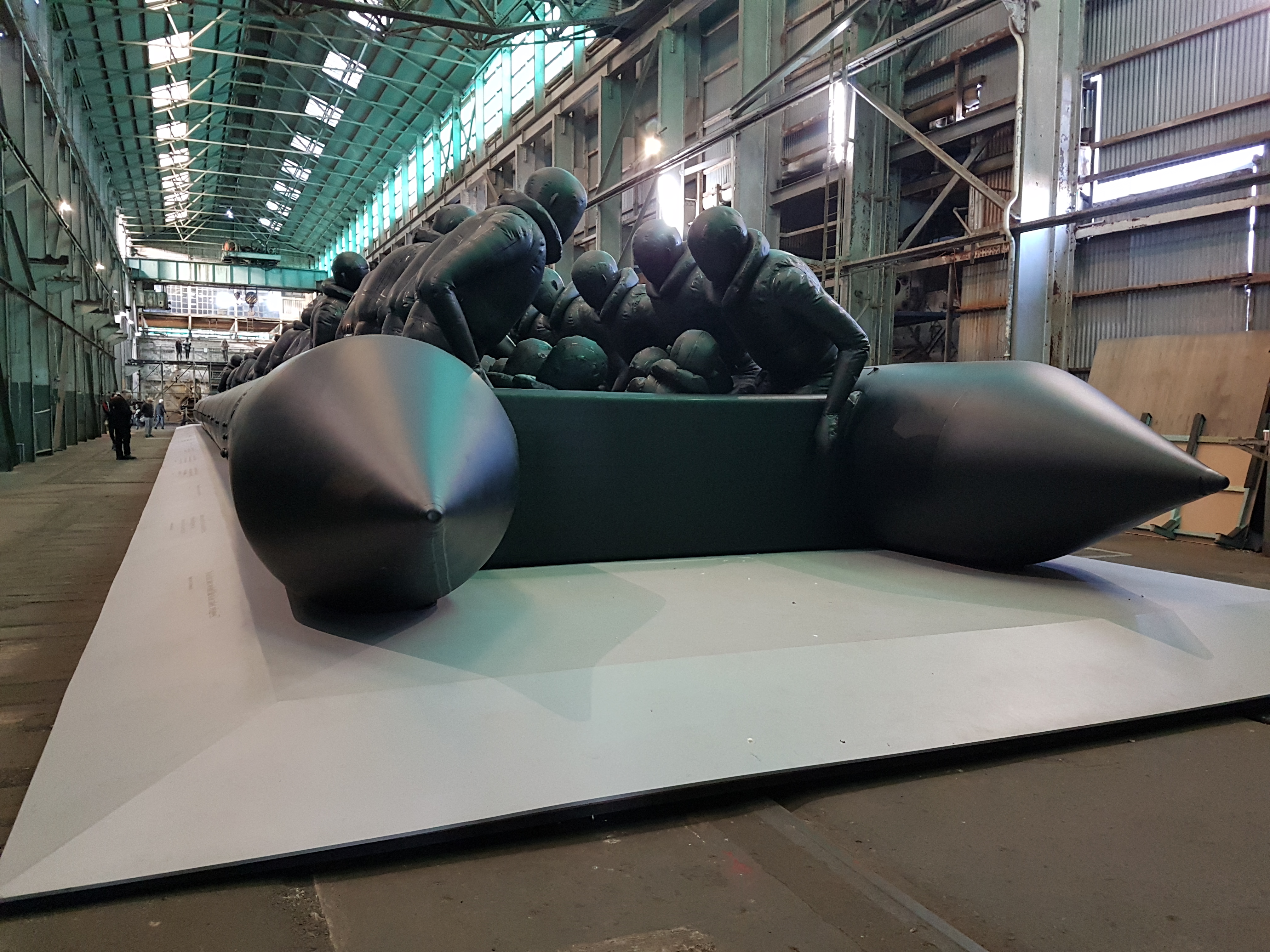
These are a few of the quotes embedded along the raft.


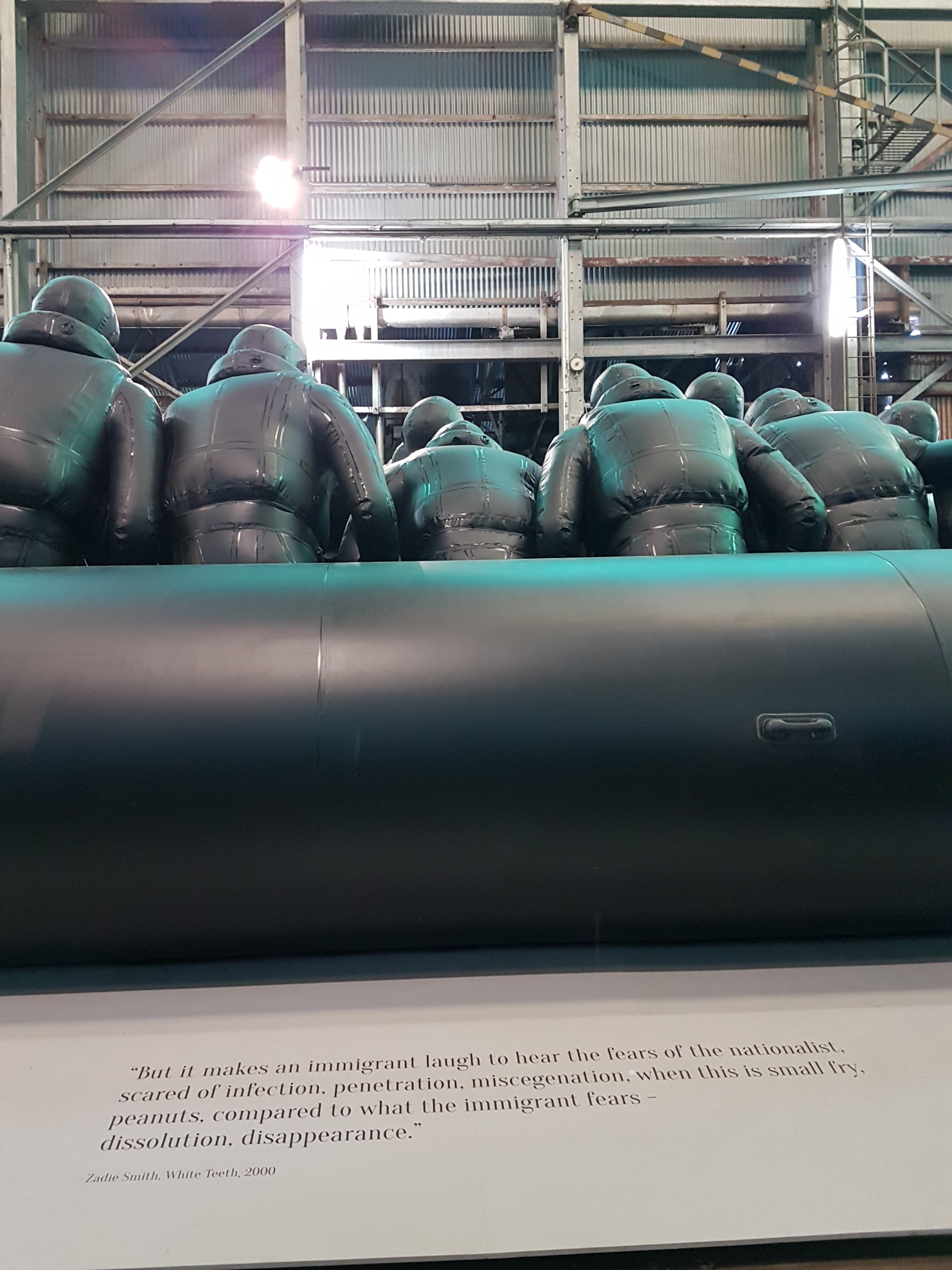


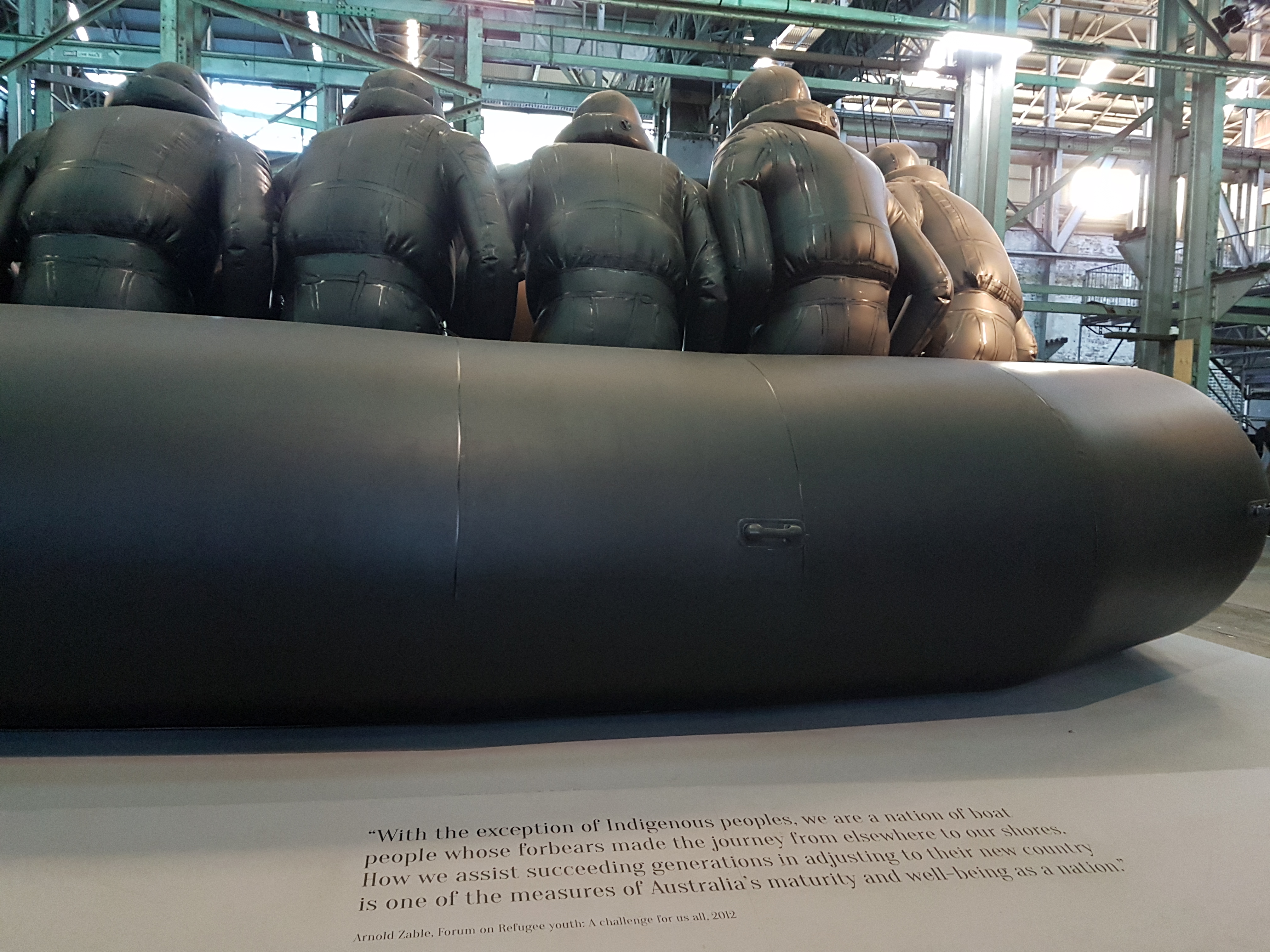
The video below shows the installation from above. My camera wobbles because the walkway swayed slightly, giving the installation additional poignancy. It is as if we are on our own raft, watching the crisis unfold, from the vantage of safety.
Weiwei participated in a conversation with the Biennale’s Artistic Director, Mami Kataoka. A Japanese artist, Kataoka is the first Asian region director of the program which has run for 44 years. Weiwei proved to be a fascinating, but challenging guest.
He was incredibly thoughtful in discussing the plight of refugees. Kataoka was wonderful and incredibly gracious in managing her self-effacing interviewee, who said art should not be discussed or analysed, but rather experienced. Weiwei began to make jokes about how the conversation was boring to the audience and he started noting the countdown of time. There was a lot of goodwill from the audience who laughed along with the jokes and cheered Kataoka, who valiantly continued to ask about Weiwei’s film, Human Flow, also on refugees.
Weiwei talked about being exhausted of talking about his art, which to him is a clumsy expression of his emotions, and specifically in this case, his inability to grasp the lack of compassion we collectively show refugees.
He also noted he’s done 350 interviews and did not want to keep talking about works that are meant to be experienced in other ways.
He expressed a sense of futility. He noted it was uncouth to mention – but did regardless – that art festivals are expensive to produce but are poorly funded. He praised Kataoka for having curated a beautiful program given these conditions.
He also said that despite the large turnout on the night, art exhibitions generally lack a large audience. He said that art was important, but it is rapidly losing attention.
He noted that the people who will go and see his documentary, filmed in multiple refugee sites around the world, and featuring the voices of hundreds of asylum seekers, will not reach the audience it needs. It will be seen by people who recognise the crisis, not those who ignore it.
Credits
Art by Ai Weiwei.
Exhibition: Law of the Journey, at the 21st Biennale of Sydney.
Photos and video by Zuleyka Zevallos, taken 20 May 2018.
 Social Science Insights