

I reflect on how to tell a good story that takes into consideration different social groups, inequity, and power relations. I also provide tips about how to measure the impact of a good story.

Beyond The Hero’s Journey
I have completed a few corporate and social policy courses about communication, and a recurring reference is “The Hero’s Journey” by Joseph Campbell. This is a narration structure that follows a character through twelve stages, where they leave their ordinary world, go on an adventure, gain mentorship, get tested, face challenges, and ultimately returns with a prize having achieved a major goal. This is fine for books and movies, but this arc doesn’t necessarily motivate social change.
Many of the stories that rely on this structure often ignore or reinforce inequity, especially regarding Black people and First Peoples. Social problems are not solved by individuals having a singular, life-affirming experience, but rather through collective action and structural change.
What makes a good story? That depends on what we mean by “good,” for whom, and to what purpose. Who gets to tell their story, and who has their story dictated to them, is an outcome of power relations.
Communication that prompts social change requires informed resources, and connections to different communities. We need to understand racial, cultural, class, gendered, sexual, disabled, and religious differences in order to tweak the story for different audiences. We need to recognise that the stories that make sense to middle class white people do not necessarily speak to everyone else.
Here are some tips you can use to think about how to tell a good story and measure its impact:

What is your key message?
Organisations doing great work seek to promote their solution to boost good health, or to recruit more people to take up improved services. A good product and a good story are not enough to motivate people to change their behaviour, especially when they are facing stress or discrimination.
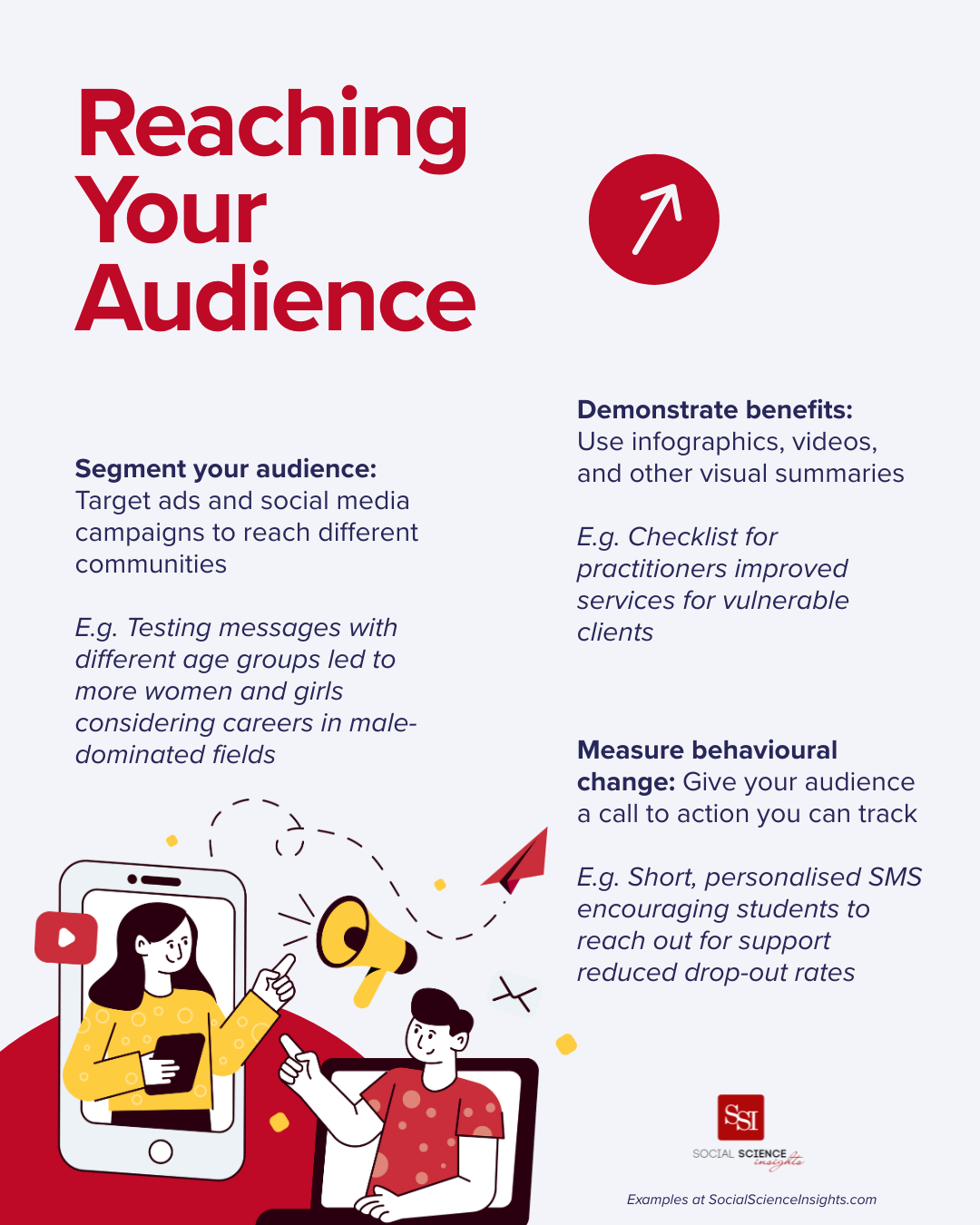
Campaigns are most effective when they clearly demonstrate specific benefits for different communities.
Few people have time to read a long webpage or a detailed report that discuss the virtues of a good product. Consider making infographics, short videos (less than two minutes), gifs, and other outputs to get your message across to different groups.
See an example of how to communicate with vulnerable people, with an example of an infographic promoting change.

Who is your audience?
To reach the broader public, consider segmenting your audience. Social media allows you to target ads and other campaigns so you can reach different groups.
See an example of how to test the same social media campaign with different messages delivered to different age groups.
How to measure impact?
Most communications campaigns measure impressions (how many people scrolled past our post) and click-through rates (how many people clicked on our link). These measures can tell us how many people clicked on a Facebook post, or how many likes an Instagram post received, or how many people viewed a TikTok. This is a great first step, however, engagement does not necessarily mean our story was understood or acted upon. Perhaps 1,000 people clicked on our link, but we don’t know how many took the next step and started our new program.
To measure behavioural change, give your audience a specific call to action you can track. Think about the time and setting when our audience will get our message (e.g. at work versus at home), and what people are reasonably able to action on the spot. If you want people to fill in a survey, make sure your link takes them directly to a simple online form, with as few questions as possible (less than 10 ideally, including demographic questions). If you want people to sign up to your event, reduce the number of fields they have to fill in and make it as easy as possible to join. For example, if you’re not tailoring the event to gender, don’t collect gender data.
See an example of how we used short, personalised SMS to encourage customers to reach out for support.
 Social Science Insights