

This week’s social science quote on social protest comes from Argentinian Marxist revolutionary Ernesto “Che” Guevara de la Serna (14 May 1928 – 9 October 1967). “If you tremble with indignation at every injustice, then you are a comrade of mine” is printed on posters, t-shirts, and mugs, and often quoted. Did Guevara really say this? Not quite.
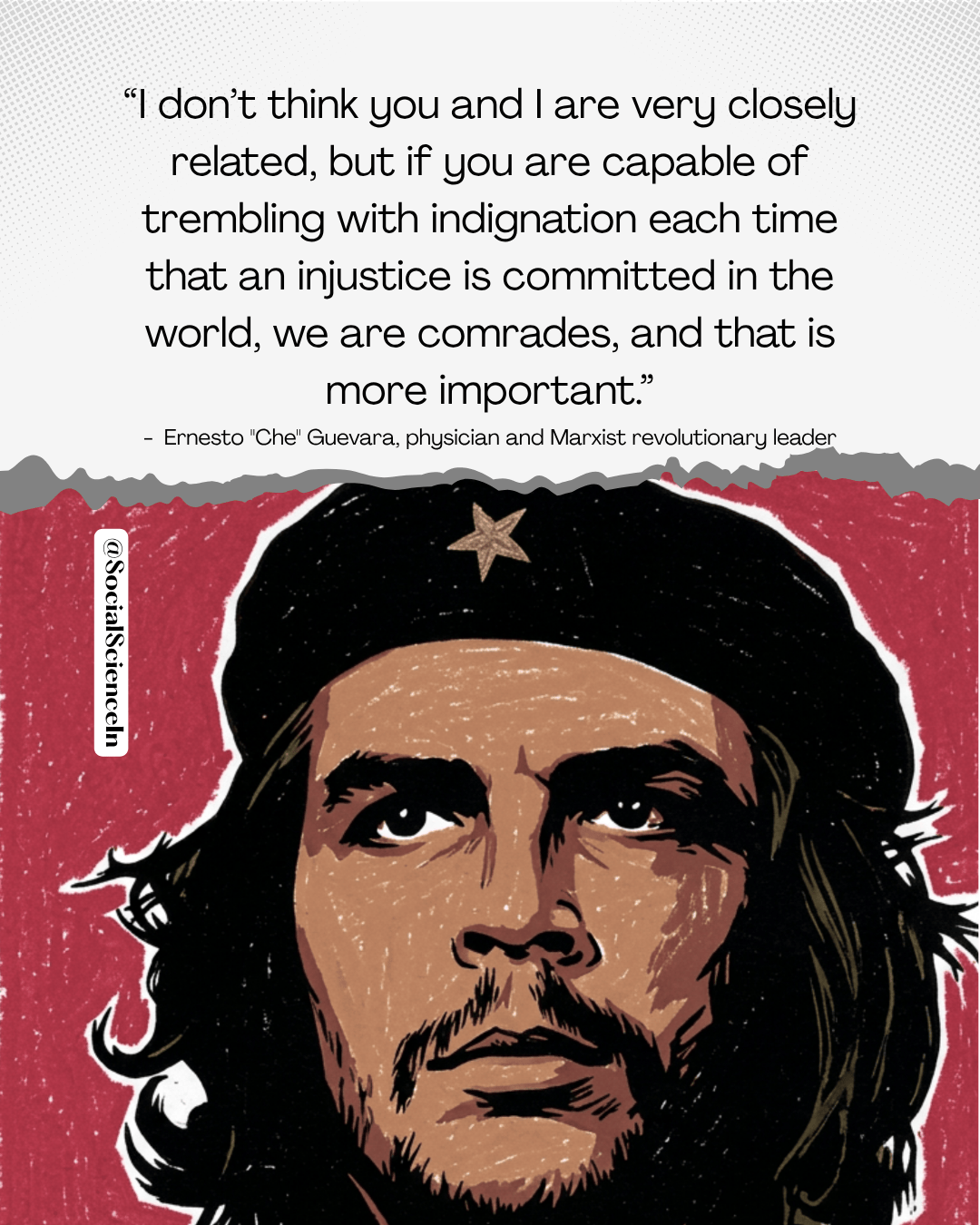
This quote comes from a letter Guevara wrote in response to María Rosario Guevara, who had written to ask whether they are related. His response is included in the section, “Twenty-Six Letters,” of Guevara’s book, The Reminiscences of the Cuban Revolutionary War. His translated words are:
“if you are capable of trembling with indignation each time that an injustice is committed in the world, we are comrades, and that is more important.”
Ernesto Che Guevara (1968: 274)
I’ve reproduced the letter from the 1968 Grove Press translation below.
Havana, February 20, 1964
“Year of the Economy”
Sra. María Rosario Guevara
36, rue d’Annam
(Maarif) Casablanca
Morocco
Compañera:
Truthfully speaking, I don’t know what part of Spain my family came from. Of course, my ancestors left there a long time ago, with one hand in front and another behind;* and if I don’t keep mine in the same place, it is only because of the discomfort of the position!
I don’t think you and I are very closely related, but if you are capable of trembling with indignation each time that an injustice is committed in the world, we are comrades, and that is more important.
A revolutionary greeting from
PATRIA O MUERTE
VENCEREMOS
MAJOR ERNESTO CHE GUEVARA
*A saying in Spanish indicating severe poverty. (This asterix note is included in the 1968 book.)
Background
“Patria o Muerte, Venceremos” means “country or death, we will prevail.” This phrase initially made famous by Fidel Castro, President of Cuba from 1959 to 2008.
The phrase “patria o muerte” was already in circulation in Cuban protest movements (for example, see this January 1959 photograph by Osvaldo Salas). Castro evoked this battle cry during a speech to commemorate La Coubre explosion, a French ship that ignited on a Havana port, on 4 March, 1960, killing workers and military members, and spreading to nearby buildings. On 5 March, Castro gave the speech, blaming the United States for the attack. He says: “Our dilemma now would be homeland or death.” He then used this phrase often.
On 7 June 1960, Castro added “venceremos” to this phrase, during a meeting of the First Congress of the National Federation of Workers of Barber and Hairdressing Workers (Primer Congreso de la Federación Nacional de Trabajadores de barbarías y peluquerías).
Guevara met Castro in 1955. Castro would eventually appoint Guevara Minister of Industries of Cuba (1961-1965).
Guevara used “patria o muerte” in his historic speech at the United Nations, on 11 December 1964. He spoke against colonisation and the United States’ incursion into Latin America. He argues for sovereignty, and in support of peace, revolution in Cuba, and liberation across Latin America.
We want to construct socialism. We have declared ourselves supporters of those who fight for peace. We have declared ourselves members of a group of unaligned countries in spite of being Leninist Marxists, because the unaligned such as us, fight against imperialism. We want peace. This new disposition of an American continent is captured and condensed into the cries which day after day is proclaimed by our masses as an irrefutable expression of their determination to fight; paralysing the armed hand of the invader. (The masses) proclaim that they count on the support and understanding of all the nations of the world, and especially the socialist forces lead by the Soviet Union.
That proclamation is, “Country or Death!”
Statement by Mr. Che Guevara (Cuba) before the United Nations General Assembly on 11 December 1964. Source: United Nations.
This speech was ten months after his sign-off on the letter to Rosario Guevara, indicating Guevara had adopted this now-national saying as a personal and political ethos.
Note
This post was revised on 2 August 2026.
Subscribe for free updates
You’ll receive an email each time we post a new article. We never share your data with anyone. Subscription is forever free.