

There are four key stages to friendships: sustaining it, developing stable closeness, making the bond satisfying, and living up to expectations beyond middle age.
William Rawlins, the Stocker Professor of Interpersonal Communication at Ohio University, speaks about his research on interpersonal communication and friendship across the life course.
Professor Rawlins has researched interpersonal communication and friendships over time. He says:
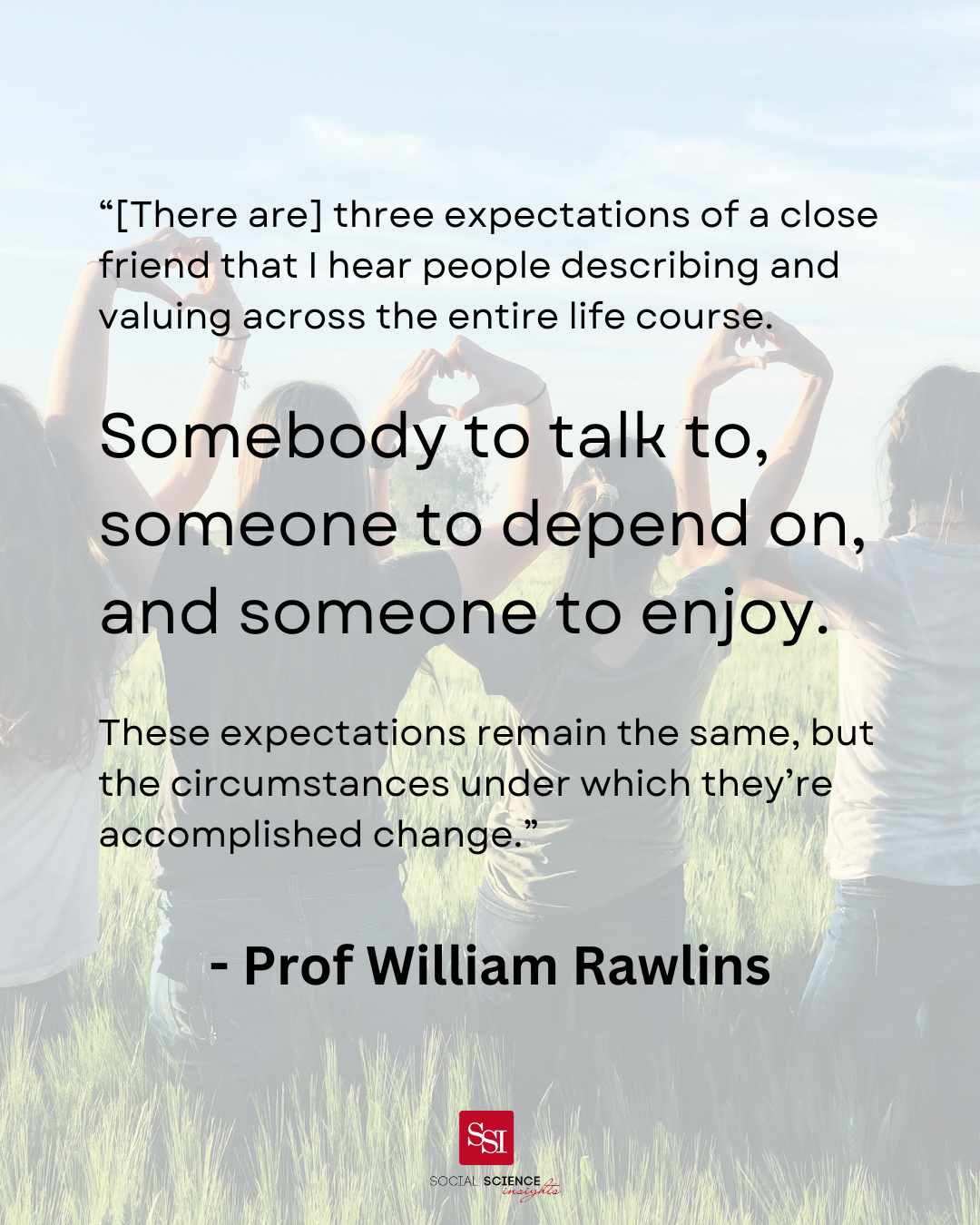
‘I’ve listened to someone as young as 14 and someone as old as 100 talk about their close friends, and [there are] three expectations of a close friend that I hear people describing and valuing across the entire life course. Somebody to talk to, someone to depend on, and someone to enjoy. These expectations remain the same, but the circumstances under which they’re accomplished change.
‘This is one thing I really want to tell you. Friendships are always susceptible to circumstances. If you think of all the things we have to do—we have to work, we have to take care of our kids, or our parents—friends choose to do things for each other, so we can put them off. They fall through the cracks.’
A/ Professor Emily Langan, communications expert, says that adult friendships end due to circumstantial reasons, not due to issues with the relationship itself. She argues that one of the ‘friendship rules’ is that ‘adults feel the need to be more polite in their friendships’:
‘We don’t feel like, in adulthood, we can demand very much of our friends. It’s unfair; they’ve got other stuff going on. So we stop expecting as much, which to me is kind of a sad thing, that we walk away from that.’
Professor Rawlins research shows that people see their friendships as continuous, despite prolonged periods of no contact. He says:
‘This is a fairly sunny view—you wouldn’t assume you were still on good terms with your parents if you hadn’t heard from them in months. But the default assumption with friends is that you’re still friends. That is how friendships continue, because people are living up to each other’s expectations. And if we have relaxed expectations for each other, or we’ve even suspended expectations, there’s a sense in which we realize that. A summer when you’re 10, three months is one-thirtieth of your life. When you’re 30, what is it? It feels like the blink of an eye.’
Read more on this interesting research exploring different stages of friendship and how social media can artificially sustain friendships that may be past their prime.
 Social Science Insights